The Gothic choir and ambulatory of the Basilica of Saint-Denis, ranks of white marble royal tombs and recumbent gisants beneath soaring pointed arches and jewelled stained glass. Saint-Denis, France.

The 1,200-year resting place of the kings and queens of France

Saint-Denis Royal Necropolis skip-the-line — step past the free nave into the paid choir where Gothic light was born, and walk the largest collection of royal tombs in Europe: the recumbent gisants, the great Renaissance monuments of François I, Louis XII and Henri II, the crypt, and the Fabrique de la flèche workshop rebuilding the lost spire.

See ticket options
  • 1144 Suger's choir — the birthplace of Gothic architecture
  • Over 70 royals Kings and queens of France, laid to rest across twelve centuries
  • Largest in Europe The greatest collection of royal recumbent effigies (gisants)
  • Fabrique de la flèche The living workshop rebuilding the basilica's lost spire

Choose your ticket

Royal Necropolis ticket

Full visit — the royal tombs and gisants, Suger's Gothic choir and ambulatory, the crypt and the Fabrique de la flèche, timed entry

€30

  • Skip-the-line timed entry to the Royal Necropolis at your chosen slot
  • The royal tombs and the recumbent gisants of the kings and queens of France
  • Abbot Suger's Gothic choir and the ambulatory of radiating chapels
  • The medieval crypt beneath the choir
  • The Fabrique de la flèche — the workshop rebuilding the basilica's spire
  • 5-minute audio history sent before your visit
Notify me when bookings open
4.8 from 64 verified travellers
Rachel M.
Manchester
“We had no idea Gothic architecture was born here. The choir is breathtaking and the rows of royal tombs are unlike anything else in France. Booking a timed slot meant we walked straight past the queue.”
Lukas B.
Munich
“The gisants are extraordinary — kings and queens lying in stone across a thousand years, all in one choir. Far calmer and more moving than Notre-Dame, and only twenty minutes from the centre on line 13.”
Camille D.
Antwerp
“The Renaissance tombs of François I and Louis XII are sculpture of the very highest order. The crypt with Louis XVI and Marie-Antoinette is sobering. A genuinely great half-day out of Paris.”

5-minute audio guide

Your Saint-Denis 5-minute guide

Hand-written, narrated by a heritage host, sent to every customer the day before their visit. Five minutes that turns a great grey church into a real story — the birthplace of Gothic light, the sleeping kings and queens of a thousand years, and the spire being raised again by hand today.

Included with your booking — your full guide arrives with your ticket.Get your guide
  • How Abbot Suger invented Gothic architecture here, with light as his guiding idea
  • Why almost every king and queen of France chose to be buried at Saint-Denis
  • The gisants and the great Renaissance tombs — the largest royal necropolis in Europe
  • The crypt, the Revolution, and the Fabrique de la flèche rebuilding the lost spire

Included free with every ticket. No app, no download — plays in any browser.

About Royal Necropolis of the Basilica of Saint-Denis

The Basilica of Saint-Denis, just north of Paris, is two extraordinary things at once. It is the birthplace of Gothic architecture — the place where, around 1140, Abbot Suger raised a new kind of choir consecrated in 1144, dissolving heavy Romanesque walls into ribbed vaults, pointed arches and a ring of radiating chapels flooded with coloured light. Suger dreamed of a church that would 'shine with the wonderful and uninterrupted light of most luminous windows', and in doing so he invented the style that would spread from here to Chartres, Notre-Dame and the great cathedrals of Europe.

It is also the royal necropolis of France — the burial place of the kings and queens of the realm for more than twelve centuries. Almost every French monarch from the 10th century until the Revolution was laid to rest here, and the choir and ambulatory hold the largest collection of recumbent funerary effigies, the gisants, anywhere in Europe. Among them stand the soaring Renaissance tombs of Louis XII and Anne of Brittany, of François I and Claude de France, and of Henri II and Catherine de' Medici — white-marble monuments that are masterpieces of French sculpture in their own right, above a crypt that holds the remains of Louis XVI and Marie-Antoinette.

Today the nave of the basilica remains a living place of worship, free and open to all. The paid visit is to the Royal Necropolis beyond it — the choir, the ambulatory, the crypt and the incomparable gathering of royal tombs — together with the Fabrique de la flèche, the on-site workshop where craftsmen are rebuilding the basilica's lost spire using medieval techniques. It is one of the most moving and least crowded historic visits within reach of central Paris: the cradle of Gothic light and the sleeping company of a thousand years of French royalty, a short Métro ride from the city.
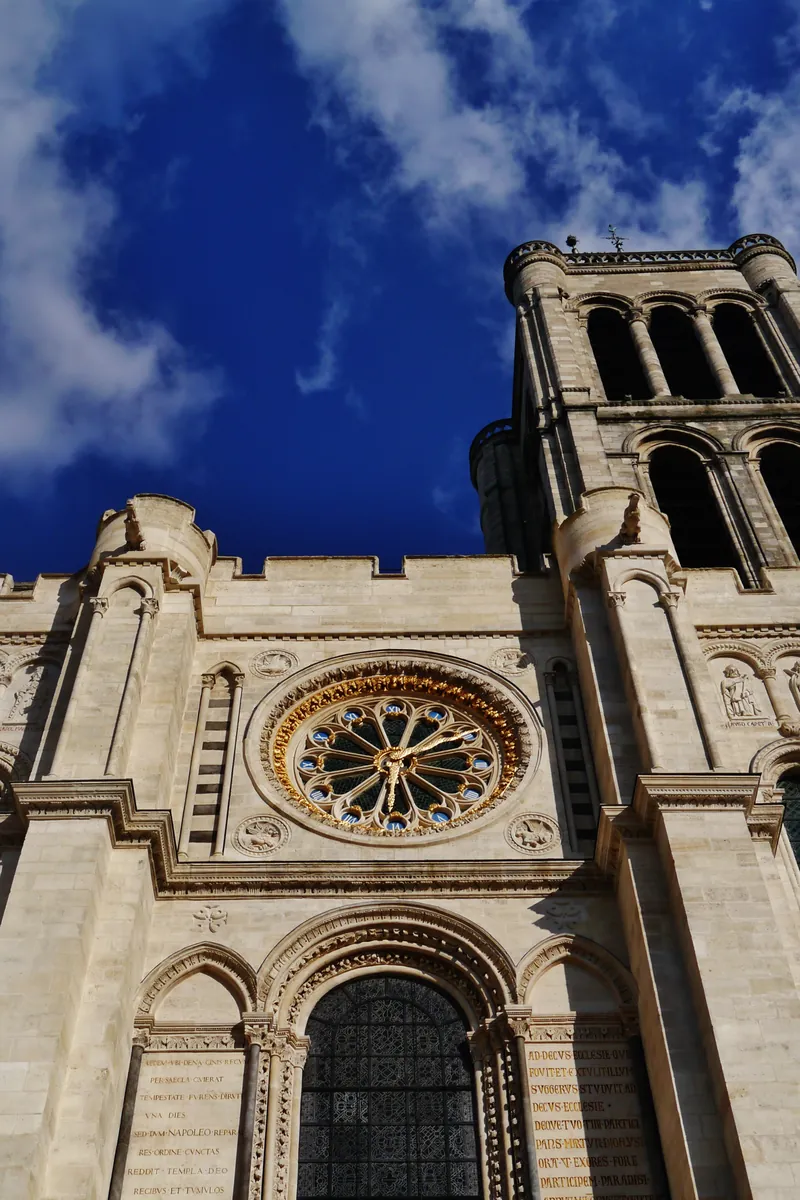
Practical information

Opening hours
Open daily. April–September: Monday–Saturday 10:00–17:45, Sunday 12:00–17:45. October–March: Monday–Saturday 10:00–16:45, Sunday 12:00–16:45. Last admission is 30 minutes before closing. Access to the Royal Necropolis may pause during religious services, and it is closed on 1 January, 1 May and 25 December. Hours can vary, so check when you book.
Address
Basilique cathédrale de Saint-Denis, 1 rue de la Légion d'Honneur, 93200 Saint-Denis, France
Getting there
In the town of Saint-Denis, just north of Paris. Métro line 13 to Basilique de Saint-Denis station is about 100 metres from the door. The RER D and tramway T1 also stop nearby. From central Paris it is roughly a 20–25 minute ride.
Time needed
Allow about 1 to 1.5 hours for the Royal Necropolis — the choir, the ambulatory, the royal tombs and gisants, the crypt and the Fabrique de la flèche. Those who love Gothic architecture or French history easily spend longer.
Accessibility
The basilica is at ground level and largely accessible, though the medieval crypt is reached by stairs and the Métro station has no lift. If you have specific mobility or sensory needs, contact us before booking and we will confirm the current accessible route and any assistance available.
Photography
Permitted for personal use without flash or tripod in most areas. The choir with its stained glass and the ranks of white-marble gisants are the signature shots, best in the strong daylight of late morning.
Food
Cafés and restaurants line the square and the market streets around the basilica in central Saint-Denis, a short walk from the door — including the lively covered market a few minutes away.

About our service

Saint-Denis Necropolis Tickets acts as a facilitator to help international visitors purchase skip-the-line, timed tickets for the Royal Necropolis of the Basilica of Saint-Denis, which is owned and managed by the French state. We do not resell tickets — we provide a personalised booking and English-language support service, and our concierge service fee is included in the displayed price. The basilica's nave is a free place of worship; our tickets are for the paid Royal Necropolis only. For those who prefer to purchase directly, the official ticket site is saint-denis-basilique.fr.

Frequently asked

What's included in the skip-the-line ticket?

Priority timed entry past the ticket queue into the Royal Necropolis — the recumbent gisants and royal tombs of the kings and queens of France, the great Renaissance monuments, Abbot Suger's Gothic choir and ambulatory, the medieval crypt, and access to the Fabrique de la flèche workshop rebuilding the basilica's spire.

Am I paying to enter the basilica? Isn't it a church?

Good question, and the distinction matters. The nave of the basilica is a living place of worship and is free to enter. Your ticket is for the Royal Necropolis — the choir, the ambulatory, the crypt and the collection of royal tombs and gisants beyond the nave, plus the Fabrique de la flèche. That is the ticketed part of the monument, and it is what we book for you: not entry to the free church, but skip-the-line timed access to the royal tombs.

Is the ticket for a specific time?

Yes — the Royal Necropolis admits visitors in timed slots to protect the monument and keep it uncrowded, so your ticket is for a chosen date and entry time. Tell us your preferred date and time when you book and we issue the ticket so you walk straight in at your slot. You can take your time inside once admitted.

What is the Basilica of Saint-Denis?

It is a great Gothic church just north of Paris that is two remarkable things at once: the birthplace of Gothic architecture, where Abbot Suger built the first coherent Gothic choir, consecrated in 1144, and the royal necropolis of France, the burial place of the kings and queens of the realm for over twelve centuries. The paid visit takes you into the choir and the necropolis with the largest collection of royal recumbent effigies in Europe.

Who is buried at Saint-Denis?

Almost every king and queen of France from the 10th century until the Revolution — around forty kings and dozens of queens, together with princes and great servants of the crown. You will see the medieval gisants, the towering Renaissance tombs of Louis XII and Anne of Brittany, François I and Claude de France, and Henri II and Catherine de' Medici, and in the crypt the remains of Louis XVI and Marie-Antoinette. It is the largest gathering of royal funerary sculpture in Europe.

Why is Saint-Denis called the birthplace of Gothic architecture?

Around 1140, Abbot Suger rebuilt the east end of the abbey church with a radically new design — ribbed vaults, pointed arches and a ring of radiating chapels whose walls dissolved into stained glass. Consecrated in 1144, this choir was the first place these elements came together into a single luminous whole, and the style spread from here to Chartres, Notre-Dame and the cathedrals of Europe. Standing in the choir, you are standing where Gothic light was invented.

What is the Fabrique de la flèche?

It is the on-site workshop where craftsmen are rebuilding the basilica's north tower and spire — 86 metres tall and dismantled in the 19th century — using medieval building techniques. Included with your visit, it lets you watch a great cathedral rise stone by stone as it would have done 800 years ago. Note the Fabrique de la flèche is closed on Mondays, though the Royal Necropolis remains open.

How long does a visit take?

Allow about 1 to 1.5 hours for the Royal Necropolis — the choir and ambulatory, the royal tombs and gisants, the crypt and the Fabrique de la flèche. Lovers of Gothic architecture or French history often stay longer; it rewards an unhurried visit.

What are the opening hours?

The Royal Necropolis is open daily. From April to September, Monday–Saturday 10:00–17:45 and Sunday 12:00–17:45; from October to March it closes an hour earlier, at 16:45. Last admission is 30 minutes before closing, and access may pause during religious services. It is closed on 1 January, 1 May and 25 December, so it is worth confirming when you book.

Can I show the ticket on my phone?

Yes. We issue an e-ticket that you present on your phone at the entrance — there is no need to print it. Just have it ready to show at your timed slot, and our concierge team is on call if anything needs sorting on the day.

How do I get to Saint-Denis from Paris?

The easiest way is Métro line 13 to Basilique de Saint-Denis station, which is about 100 metres from the door — roughly a 20 to 25 minute ride from central Paris. The RER D and the tramway T1 also stop nearby. Note that the Métro station itself has no lift.

Do children and young people need a ticket?

Under-18s enter free, and residents of the EU or EEA aged 18 to 25 also enter free with valid ID checked on site. We only ever charge for a full-price adult ticket — so if everyone in your group qualifies for free entry, there is nothing to book. Tell us your group when you enquire and we will make sure only the tickets you actually need are issued.

Is the Royal Necropolis wheelchair accessible?

The basilica is at ground level and the choir and necropolis are largely accessible, but the medieval crypt is reached by stairs and the nearest Métro station has no lift. If you have specific mobility or sensory needs, contact us before booking and we will confirm the current accessible route and any assistance the monument offers.

Can I take photographs inside?

Yes — photography for personal use is permitted in most areas without flash or a tripod. The choir with its stained glass and the ranks of white-marble gisants are the signature shots, and they are at their best in the strong daylight of late morning. Please be discreet if a service is taking place in the nave.

Is it suitable for children?

Yes. The visit is a manageable length, and the tombs, effigies and the story of a thousand years of kings and queens tend to capture children's imagination. The Fabrique de la flèche, where a cathedral spire is being rebuilt by hand, is a highlight for younger visitors — bear in mind it is closed on Mondays.

How is Saint-Denis different from Notre-Dame or the big Paris churches?

Saint-Denis came first — it is where the Gothic style Notre-Dame and Chartres inherited was born — and it is unique in being the royal necropolis of France, with a choir full of royal tombs you will find nowhere else. It is also far quieter than the great central-Paris churches, so you can take in the architecture and the tombs in calm, a short Métro ride from the city.

Can I change the date or time?

Your ticket is for a chosen date and entry time. If you need to move it, reply to your confirmation email as early as you can and our concierge team will do its best to adjust the booking with the monument wherever its calendar allows.

Can I combine it with other sights?

Easily. Saint-Denis pairs naturally with the Panthéon in central Paris — the two great resting places of the nation, one royal, one republican. Because the necropolis visit is compact and its entry is timed, it slots neatly into a Paris day around a visit to the Panthéon or the museums of the centre.